The bed is the anchor of every bedroom. It takes up more floor area than any other piece, it decides where the wardrobe doors and the walkways go, and it is used every single night for a decade or more. Yet it is often bought last, in a rush, matched to a mattress that was chosen first. Knowing how to choose a bed for Indian bedrooms means starting from the room dimensions and the way your household actually sleeps, then working outward to storage, material and finish.
This guide covers the decisions that matter: picking the right size for Delhi NCR flat proportions, deciding between a storage bed and a non-storage bed, choosing a frame material that survives humidity and termites, and matching the bed to a mattress without gaps or overhang. It also lays out realistic costs so you can read a quote fairly.
Start With the Room and the Clearances
Before looking at a single headboard style, measure the bedroom and mark the wall the bed will sit against. In most Indian bedrooms the bed faces the wardrobe wall, with the window on one side and the door on the other. The bed width is limited by that wall, and the length is limited by how far it can project before it blocks the wardrobe or the bathroom door.
Three clearances decide whether a room feels calm or cramped:
- Bed to wardrobe: leave at least 75-90 cm so the shutters open fully and someone can stand in front of an open wardrobe.
- Bed sides: keep 60-75 cm of walking space on both sides of a double bed so two people are not climbing over each other.
- Foot of the bed: 60 cm or more to the opposite wall or dresser, so the room has a path around it.
Confirm the doorway and lift width the bed frame or box has to pass through, too. A one-piece king box bed that will not fit in a Delhi NCR service lift is a common and costly surprise on delivery day. Our furniture layout guide for Indian homes covers how to plan these clearances room by room.
Bed Size Guide for Indian Homes
Indian bed sizes are quoted in inches and vary slightly by brand, but these are the working figures:
- Single: 36 x 78 in — for a child's room or a compact guest room.
- Double / small queen: 48 x 78 in — fits two adults at a squeeze; good for a 10 x 10 ft second bedroom.
- Queen: 60 x 78 in — the default for most master bedrooms in flats.
- King: 72 x 78 in — needs a room of about 13 x 14 ft or larger to keep the side clearances.
As a rough room-to-bed match: an 11 x 12 ft to 12 x 14 ft master bedroom takes a queen comfortably. Only bedrooms above roughly 13 x 14 ft carry a king without losing walking space or wardrobe access. A 10 x 10 ft room should stop at a queen, and often works better with a 48-inch double plus a slim bedside unit. Our master bedroom interior design guide goes deeper on laying out the rest of the room around the bed.
A bed one size too big does not make a bedroom feel luxurious. It makes it feel like a bed with a room wrapped tightly around it.
Storage Bed vs Non-Storage Bed
The storage bed vs non-storage bed question comes up in almost every bedroom consultation, and the honest answer depends on how much wardrobe and loft space the room already has.
- Hydraulic lift-up storage: the whole mattress platform lifts on gas pistons to reveal a deep box underneath. Best for holding suitcases, spare quilts, and off-season clothing in flats that are short on storage. Buy good-quality Italian or branded pistons — cheap ones sag within a year and the platform drops.
- Drawer storage: two or four drawers in the base. Easier to access daily than a lift-up box, but shallower and blocked if the bed sits close to a wall on the drawer side.
- Box storage without hydraulics: a fixed box you access by lifting the mattress by hand. Cheapest, but awkward, so it tends to hold things you rarely need.
- Non-storage / platform bed: lighter, cheaper, easier to move between homes, and it lets the mattress breathe from below, which matters in humid and coastal climates. The right choice when the room already has a full-height wardrobe with a loft.
If you do go with storage, keep heavy and rarely used items in the bed box and everyday clothing in the wardrobe — a bed box is hard to open when you are half asleep. Our wardrobe design ideas for Indian homes can help you work out whether you actually need the extra bed storage at all.
The Best Bed Material for Indian Homes
The best bed material for Indian homes is the one that stays stable through monsoon humidity, resists termites, and is not so heavy that it cannot be moved when you shift house.
- Solid seasoned hardwood (sheesham, teak, kiln-dried mango): the benchmark for a bed meant to last 15-20 years. It tolerates Delhi's humidity swings and can be repolished. Heavy and the most expensive option.
- BWP / BWR grade plywood with laminate or veneer: the best value for most homes. Dimensionally stable, termite-treated, lighter than solid wood, and available in any finish. Insist on 18-19 mm ply for the main panels.
- Engineered wood / particle board box beds: found in the cheapest online sets. The joints loosen, and the panels swell permanently if they ever get wet from a leak or a mopping accident. Avoid for the load-bearing structure.
- Metal frame beds: light, cheap, and immune to termites, but they can develop a squeak at the joints and the styling options are limited. Fine for a guest room or a rental.
For a custom bed, a BWP ply carcass with a solid wood headboard frame is a common Delhi NCR compromise — you get the stability of ply where it matters and the look and repairability of solid wood where you touch it. Our comparison of plywood vs MDF for modular furniture in India explains why the board grade is worth checking in writing.
Matching the Bed to the Mattress
A bed and mattress that do not match create a daily annoyance — a gap that swallows phones and pillows, or an overhang that catches your shin. A few rules keep them aligned:
- Match the internal frame size to the mattress size, not the external bed size. Ask the seller for the internal clear dimension and buy the mattress to that.
- Check the platform type. Solid ply platforms suit foam and bonded-foam mattresses; slatted platforms suit spring and latex mattresses that need airflow. A spring mattress on a sealed box can trap moisture.
- Mind the total height. Bed base plus mattress should put the sleeping surface around 55-65 cm off the floor for easy sitting and standing. A thick 20 cm mattress on a tall storage base can end up uncomfortably high, especially for older family members.
- Leave the headboard clear. If the mattress is taller than expected, it can hide half the headboard — factor that into the design.
Headboard, Style and Finish
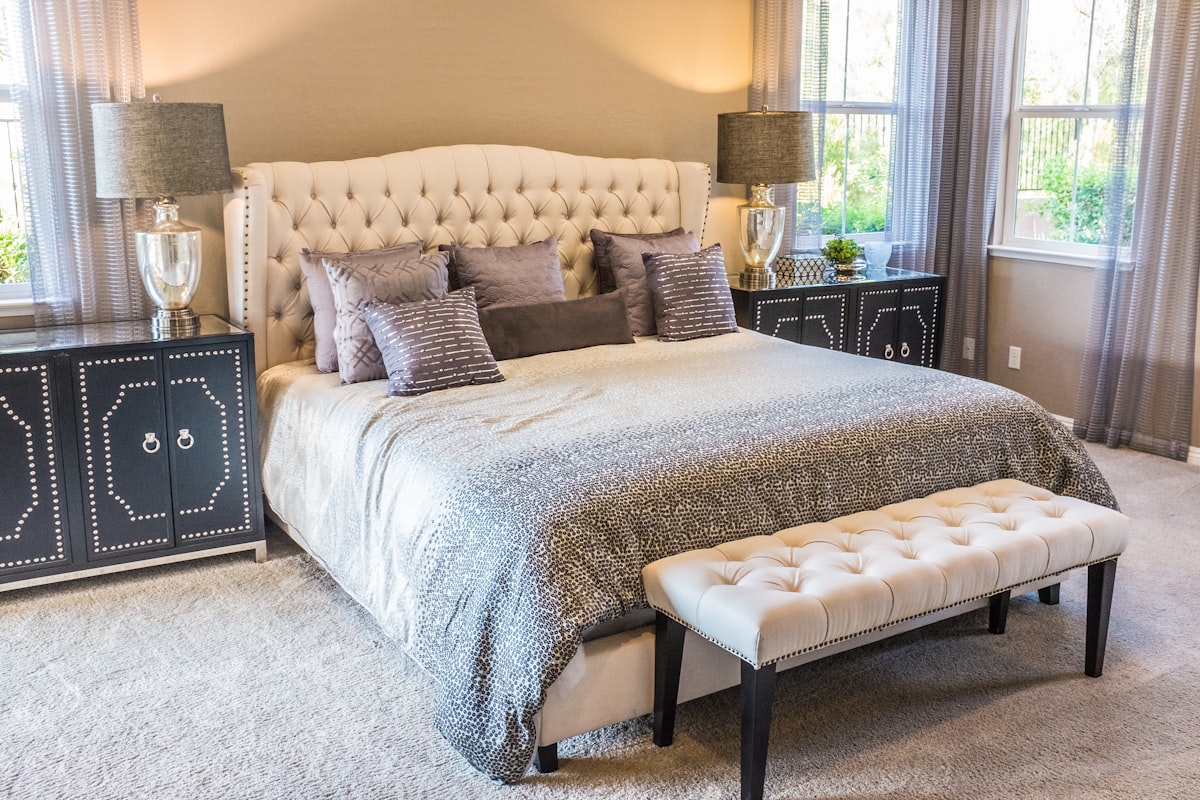
The headboard is the part you see and lean against, so it earns some attention. Upholstered headboards in a stain-resistant fabric or leatherette are comfortable to sit against for reading and are easy to restyle later. Wood and laminate headboards are lower maintenance and pair well with a fluted or panelled treatment that ties into the wardrobe. Keep a few principles in mind:
- Keep the bed finish calm. The bed is a large surface — a quiet wood tone or neutral upholstery ages better than a bold colour or high-gloss finish that dates.
- Match the visual weight to the room. A tall, deep, heavily tufted headboard needs a large room; a slim low headboard suits compact flats.
- Coordinate with the wardrobe and flooring, so the bed sits within the bedroom palette rather than competing with it.
- Skip the footboard in small rooms. A footboard adds length and visual bulk you rarely need.
Bed Costs in Delhi NCR
Prices vary widely; knowing the bands helps you judge a quote:
- Entry ready-made queen, no storage: Rs. 10,000-18,000. Usually a particle-board or thin-ply box — acceptable for a rental or a guest room, not for daily use over a decade.
- Mid to premium ready-made queen: Rs. 18,000-40,000 from established brands, with a solid wood or thick-ply frame.
- Hydraulic storage bed: Rs. 30,000-70,000 depending on frame material, finish, and piston quality.
- Custom bed via a local carpenter: roughly Rs. 25,000-55,000 in BWP ply with laminate, or Rs. 55,000-1,20,000 with a solid wood frame and veneer.
- Mattress (separate): a good queen mattress is Rs. 15,000-45,000 on top of the bed.
Custom is often the better value in Delhi NCR if you have a trusted karigar — you control the board grade, the piston brand, and the exact internal size, and you can match the finish to the wardrobe. If the bed is part of a larger project, sequence it against the bigger decisions using our home renovation planning guide, the same way you would plan a sofa purchase around the living room.
Getting Your Bed Choice Right
Knowing how to choose a bed for Indian bedrooms comes down to sequence: measure the room and the lift first, fix the size to your clearances, decide honestly whether you need storage, then pay for the frame material and the mattress fit. Treat the headboard style and finish as the layer on top. A bed chosen this way keeps the bedroom calm and usable for years, while one bought for its showroom looks tends to crowd the room or fight the mattress within months. At Re:Room, we specify the bed alongside the full bedroom layout, wardrobe, and lighting, so the largest piece in the room actually fits the room it lands in.
Not sure which bed fits your bedroom?
Our designers size, spec, and place your bed as part of the whole room — wardrobe, lighting, and palette included. Let us help you get the biggest decision right the first time.
Book a Free ConsultationFrequently asked questions.
What bed size should I buy for a master bedroom in an Indian flat?
For most Delhi NCR master bedrooms of 11x12 ft to 12x14 ft, a queen bed (60x78 inches) is the practical choice — it sleeps two comfortably and still leaves walking space on both sides and at the foot. Go for a king (72x78 inches) only if the room is 13x14 ft or larger, or you will lose the side clearances and the wardrobe shutters may not open fully. In a compact 10x10 ft second bedroom, a queen is the maximum and a smaller 48x78 inch double often works better.
Is a storage bed or a non-storage bed better for Indian homes?
A storage bed makes sense in flats short on wardrobe space — a hydraulic lift-up box holds spare quilts, suitcases, and seasonal clothing that would otherwise fill a loft. A non-storage bed is lighter, cheaper, easier to move, and lets the mattress breathe, which suits humid and coastal climates. If your bedroom already has a full-height wardrobe and a loft, a non-storage bed with simple drawers is usually enough.
Which bed material lasts longest in Indian conditions?
Solid seasoned hardwood such as sheesham or teak lasts 15-20 years and tolerates Delhi's humidity swings, but it is heavy and expensive. A BWP or BWR grade plywood bed with a laminate or veneer finish is the best value for most homes — stable, termite-treated, and lighter to move. Avoid particle board or MDF box beds for the base structure, as the joints loosen and the panels swell if they ever get wet.
How much does a good double bed cost in Delhi NCR?
A durable ready-made queen bed without storage from an established brand costs roughly Rs. 18,000 to Rs. 40,000 in Delhi NCR. A hydraulic storage bed runs Rs. 30,000 to Rs. 70,000 depending on frame material and finish. A custom bed built by a local carpenter in BWP ply with laminate costs about Rs. 25,000 to Rs. 55,000, plus the mattress, which is a separate Rs. 15,000 to Rs. 45,000 for a good queen.